Game Rules
Euchre rules: the 24 card game played right
Euchre is the fastest partnership trick game in the American parlor, and nearly every dispute at the table dissolves once the standard game is laid out deal by deal.
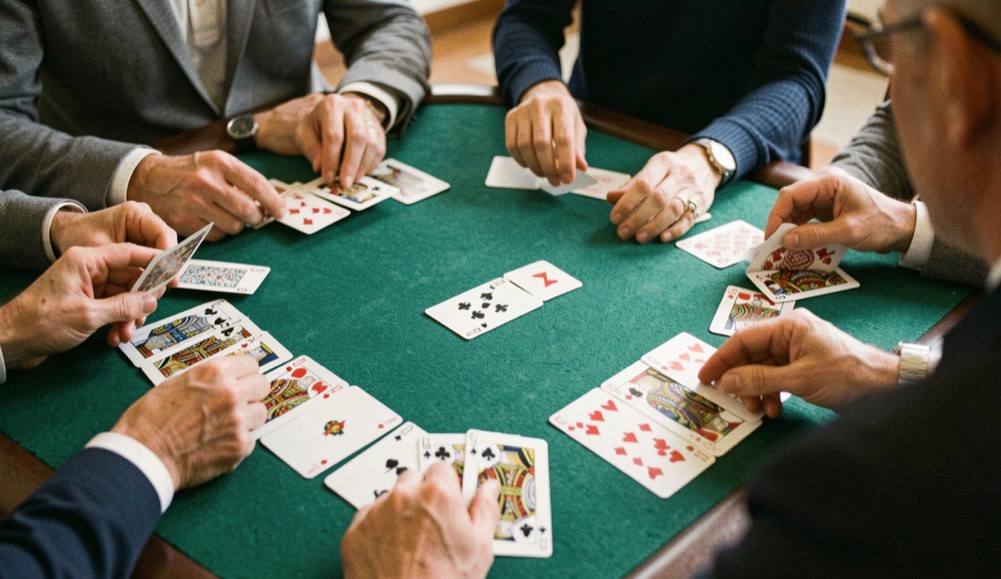
Euchre is played by four players in fixed partnerships, partners sitting across the table, with a stripped deck of twenty four cards: nines through aces in all four suits. Five cards go to each player, usually dealt in rounds of two and three so that the hands stay even, and the four undealt cards sit face down in front of the dealer. The whole game hangs on one turned card and on two jacks that outrank everything, so the rules below follow a single deal from start to score.
The deck, the deal and the kitty
Remove the twos through eights before sitting down; a euchre hand is twenty four cards and nothing else. The player to the dealer's left may cut, and the dealer passes five cards to each player in two rounds, then turns the next card face up on the remaining four, which stay as a kitty. Dealing rotates clockwise after every hand, and the dealer position matters more in euchre than in any other parlor game, because the dealer's partner and the dealer both get a chance to accept the suit of that turned card as trump.
Making trump: order up or pass
Starting at the dealer's left, each player in turn either accepts the turned card's suit as trump or passes. A player who accepts says so by taking the turned card into hand and discarding one face down; that acceptance is called ordering up when the decision belongs to an opponent, and assisting when it belongs to the dealer's partner. If all four players pass, the turned card is turned down, and a second round follows in which each player, the dealer included, may name any of the other three suits as trump or pass again. When a player names trump in this second round, the dealer completes the kitty discards, and play begins. If everyone passes twice, the hand is thrown in and the same dealer deals again.
| Card | Name at the table | Notes |
|---|---|---|
| Jack of trump | Right bower | The highest card in the game |
| Other jack of the same color | Left bower | Counts as trump for following suit |
| Ace of trump | Boss ace | Third best overall |
| King, queen, ten, nine of trump | Trump litter | In that order |
| Ace down to nine, other suits | Off suit cards | Ace high, nine low, left bower removed from its true suit |
Playing the hand
The player to the dealer's left leads to the first trick. Each player must follow suit if able, and the two jacks follow the trump rule written above: the left bower is trump for every purpose, including following suit when trump is led. Highest trump wins the trick, or the highest card of the led suit if no trump was played; the winner leads next. Five tricks are contested in a hand, and the hand is scored as a whole when the fifth trick is gathered.
Going alone
When making trump, a player may declare alone: the partner lays her cards face down and sits the hand out. Alone declarations win the biggest scores in the game, four points for taking all five tricks instead of two, but they play at three hands against one. The standard game allows the defenders to defend alone as well by convention in some tables; the published partnership game keeps both defenders active, and that is the version tournaments play.
Scoring the hand
Scoring is settled the same way everywhere the standard game is played:
- Makers take three or four tricks: one point, called the point.
- Makers take all five tricks: two points, called the march.
- Lone maker takes three or four tricks: one point.
- Lone maker takes all five tricks: four points.
- Defenders take three or more tricks: two points to the defenders, and the makers are said to be euchred.
- Euchre against a lone maker scores the same two points in the published game.
Game is ten points; most tables extend to eleven or fifteen for a longer evening, but ten is the published game and the tournament game.
Common mistakes
The recurring errors are few and expensive. Calling the left bower by its printed suit and refusing to follow with it when trump is led, which is a revoke and costs the offending side one or two tricks by the standard penalty of two points. Dealing six cards because the dealer picked up the turned card before discarding, which steals a trick from the arithmetic. Forgetting that a second round pass by everyone throws the hand in rather than passing the deal. And scoring a five trick alone march as two points instead of four, the most common arithmetic slip in the parlor.
The deal that settles it
If your table remembers three sentences, remember these: the left bower is always trump; three tricks make the point and five make the march; and the dealer always finishes the kitty with a discard before the first lead. Everything else follows from the deal above. When the table is ready to win rather than merely play, the counting begins in the euchre strategy guide, and the story of how this German game conquered the Ohio valley waits in the history of euchre.
The questions this page settles for one deal come back at tournament scale: how a whole season ranks its players instead of one evening, in brackets and pyramids; how television compressed a championship into a single night bracket; how a duel and a field price an error differently in match play and stroke play; and where the tables themselves are found, from lodge halls and Legion rooms to the family game night.