Game Rules
Pinochle rules: partnership auction pinochle
Pinochle looks intimidating for one round of bidding, then reveals itself as the most arithmetic-friendly game in the parlor: count meld, count tricks, make the bid.
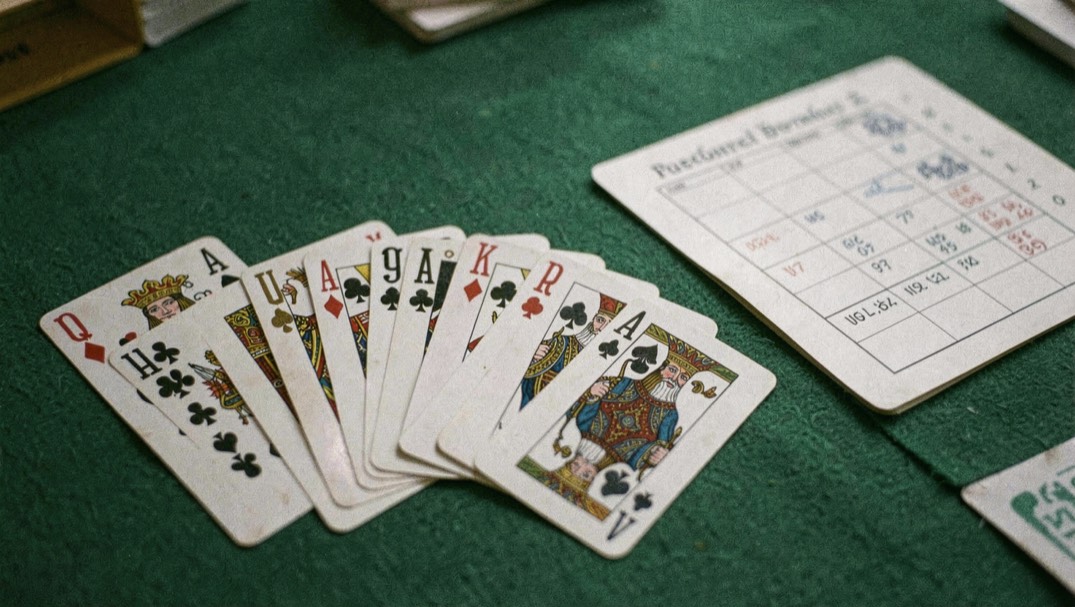
Partnership pinochle is played by four players, partners opposite, with a forty eight card deck built from two copies of every card from nine to ace. Twelve cards go to each player, there is no kitty in the four handed partnership game, and every deal is a small auction: the partnership that buys the contract must produce enough meld and enough trick points to cover the bid, or the hand goes down in flames. The game rewards memory and counting more than daring, and the rules below follow the published standard.
The deck and the deal
Shuffle two copies of every rank from nine to ace; the doubling is the point, because paired ranks make melds possible and because high cards multiply. Deal twelve cards to each player. A suit named trump puts twenty four trump cards in play across the deal, and a player holding six or more of them owns the hand's weather. Deal rotates clockwise, and the player at the dealer's left opens the bidding.
The auction
Bidding proceeds clockwise, each bid higher than the last, in units of one point, with an opening minimum the standard game sets at fifteen, though many published rulesets put it at twenty, so the table should fix the number before play. A bid is a promise: meld plus trick points equal to at least the bid when the hand is scored. Passing removes a player from the auction. When two consecutive players pass, the highest bidder names trump, and play begins. A prudent partnership passes early with fewer than nine sure points between meld and aces; the counting habits come from the strategy suite.
Meld: the first score of the hand
After trump is named, each partnership lays out and scores its meld, combinations claimed from the twelve card hands. The standard values are the ones below, and tables that grew up on different numbers should agree on one set and write it on the score sheet; the values themselves are the published game.
| Combination | Meld points | Notes |
|---|---|---|
| Run: ace, ten, king, queen, jack of trump | 15 | One extra king or queen in trump adds its marriage value |
| Double run: both copies of the run | 150 | Counts instead of, not in addition to, the single run |
| Marriage in trump | 4 | King and queen of trump |
| Common marriage, any other suit | 2 | Scored once per suit |
| Pinochle: jack of diamonds, queen of spades | 4 | The combination that named the game |
| Double pinochle | 8 | Both copies |
| Aces around | 10 | An ace in every suit; 100 for the double |
| Kings around / queens around / jacks around | 8 / 6 / 4 | One of each in every suit |
| Dix: nine of trump | 1 | Scored by the holder after taking one trick |
Playing the tricks
Trick play in pinochle has one famous wrinkle: within the led suit the order runs ace, ten, king, queen, jack, nine. The ten is the second best card of every suit, which surprises bridge players and delights everyone else. The high bidder leads to the first trick. You must follow suit, and if you cannot follow you must play trump if you hold it; sloughing a discard while holding trump is not allowed. Highest trump wins the trick, or the highest card of the led suit when no trump appears. Two hundred and forty points ride on the trick cards of every deal, and last trick adds ten more: the count is fixed at 250 total points per deal.
| Card | Points each | All eight copies |
|---|---|---|
| Ace | 11 | 88 |
| Ten | 10 | 80 |
| King | 4 | 32 |
| Queen | 3 | 24 |
| Jack | 2 | 16 |
| Nine | 0 | 0 |
| Last trick | 10 | brings the deal to 250 |
Scoring the hand
When the twelfth trick is gathered, the bidding partnership adds meld to trick points. If the sum reaches the bid, both partners score their meld and their trick points; if it falls short, the partnership goes set and scores nothing, while the defenders score their meld and their tricks regardless. Game is 150 points, and a partnership that goes set twice in a row has usually bid against its own hands twice, not against its luck.
Common mistakes
New tables make the same five errors. Bidding the meld alone and forgetting that trick points must still be won. Sloughing off suit while holding trump, illegal and visible. Playing the king of the led suit under an outstanding ten, the classic pinochle heartbreak. Scoring the double run as 150 on top of the single run instead of instead of it. And letting the dix score before its holder has taken a trick, which the standard game forbids.
The count that wins
Pinochle is a game of two ledgers, meld and tricks, and the rules above are the whole ledger. The full numbers with variants argued are collected in the pinochle scoring guide; the bidding counting lives in the strategy suite; and the story of how French binocle became the union hall game is told in pinochle history. Deal, bid, meld, take your tricks, and write everything down: the game rewards the table that keeps the count.