Hosting Game Nights
How to host a classic card game night
A card night is won or lost before the first shuffle: light, tables, food, pace and one host decision that matters more than any rule, ending while the room still wants one more hand.
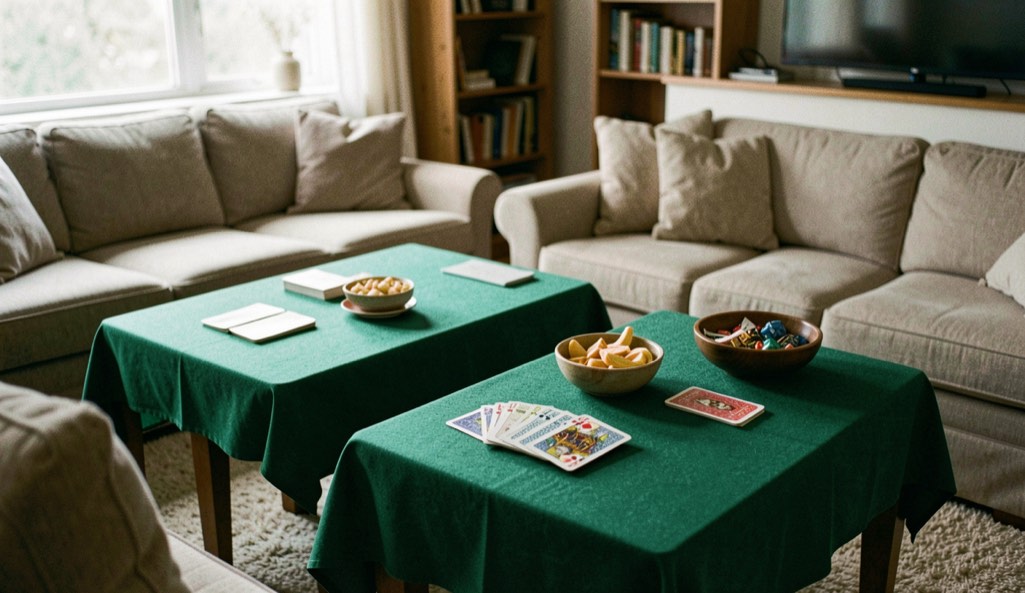
The games take care of themselves; the evening does not. Host a card night well and the same four players return every month for years, because the evening had a shape: a warm up game, a main game, a declared ending and the promise of the rematch. Host it badly, with the wrong light, the wrong chairs and no ending, and even euchre cannot save it. The craft below is the organizer side of every guide on this site.
The room: light, table, chairs
Card games are read at a distance of two feet by eyes of every age, so the light matters more than the furniture: a bright overhead plus one lamp per table beats any mood lighting a host has ever defended. The table wants elbow room, a felt cloth or mat so cards deal cleanly and can be gathered quietly, and chairs at the right height, because a three hour game on a stool is a two hour game in practice. Two tables of four beat one table of eight; the parlor classics are four handed, and the second table doubles the evening's energy instead of halving it.
The equipment: decks, scores, spares
One fresh deck per table per game, plus one spare in the drawer, because a bent card discovered mid deal ruins the rhythm of a whole evening. Hand and Foot nights are the exception that swallows decks wholesale, which is why the equipment list there gets its own guide. Add two pencils per table and pre ruled score sheets, because the host who hands a table a ready sheet has already prevented the evening's only predictable argument. A proper sheet is the cheapest equipment in the house and the first thing guests notice is missing when it is absent.
The food rule: grease is the enemy
Every veteran host serves the same warning with the snacks: anything greasy transfers to the cards, and cards remember. Serve dry finger food, bowls with rims, napkins everywhere and coasters at every right hand; keep the messy food on a separate table, physically away from the play, and the decks of the house will outlive the decade. Drinks ride coasters or they ride on the floor, and the host says this cheerfully exactly once, at the door, when it sounds like hospitality instead of policing.
| Clock | What happens | Host job |
|---|---|---|
| 7:00 | guests arrive, snacks, table assignment | seat the foursomes before the games start |
| 7:20 | warm up game: hearts or euchre, one sitting | keep the rules sheet visible at each table |
| 8:00 | main game: spades, pinochle or the tournament rotation | run the clock, keep the score sheets honest |
| 9:45 | break: refill, stretch, totals read aloud | announce the ending time out loud |
| 10:30 | declared end of the last rubber or round | end it while the room wants one more hand |
The schedule and the declared end
The single most professional thing a host does all evening is announce the ending time and keep it. Card nights die by drift: one more rubber becomes three, the strong players will not leave and the tired players will not say so. A declared end, kept honestly, does the opposite: players race the clock, the last rubber means something, and everyone leaves at their best memory of the evening. The ending is also where the rematch is declared, the date circled, and the tournament bracket or rotation for next time half written before coats are found.
The fifth chair problem
Every host meets the odd number: five confirmed, or four plus the neighbor who heard the laughter. The published games have answers, and the host should know them before the doorbell. Hearts and Spades both have standard three handed forms in the card literature, and a cut version of euchre exists, but the better answer at a mixed table is the rotating seat: with five players, the odd chair deals each game while playing the next, a rhythm every parlor has used and no guest resents. What does not work is kibitzing, the fifth chair coaching over shoulders, which turns one extra guest into five annoyed ones. Decide the rotation out loud, at the table, before the first deal.
Teaching without lecturing
A card night that introduces a new game needs a teaching plan shorter than the game. Deal a sample hand face up, walk the bowers or the meld staircase once, print the rules guide from this site and stand it at the table, and let the first game be a friendly one whose score nobody records. The worst teaching happens mid hand, six minutes of explanation for every trick; the best happens before the deal, and the second best happens next morning, when the same guest asks for the rules page in writing and finds it here.
Common mistakes
Starting the main game with five players and letting the fifth kibitz for an hour. No spare deck, so a split king ends the evening early. Serving wings at the card table, which the decks will document. Letting the warm up game run long, which squeezes the main game into an exhausted final half hour. And ending by exhaustion instead of by declaration, so the last memory of the evening is everyone shuffling for coats instead of the tally being read aloud.
The host's whole job
Light, tables, decks, dry snacks, a clock and a declared end: the rest is the games' business. For the format that turns a good night into a tournament, see the euchre rotation night; for the sheets to rule before the doorbell rings, the score sheets guide does it in a minute; and for the family game that anchors a whole winter of nights, Hand and Foot is waiting with its four decks and four rounds.