Scoring & Sheets
Bid Whist scoring: books, Boston and the kitty
Bid Whist counts in books: six tricks belong to everyone, the rest are sold at auction, and the scoring turns each sold book into points the sheet can prove.
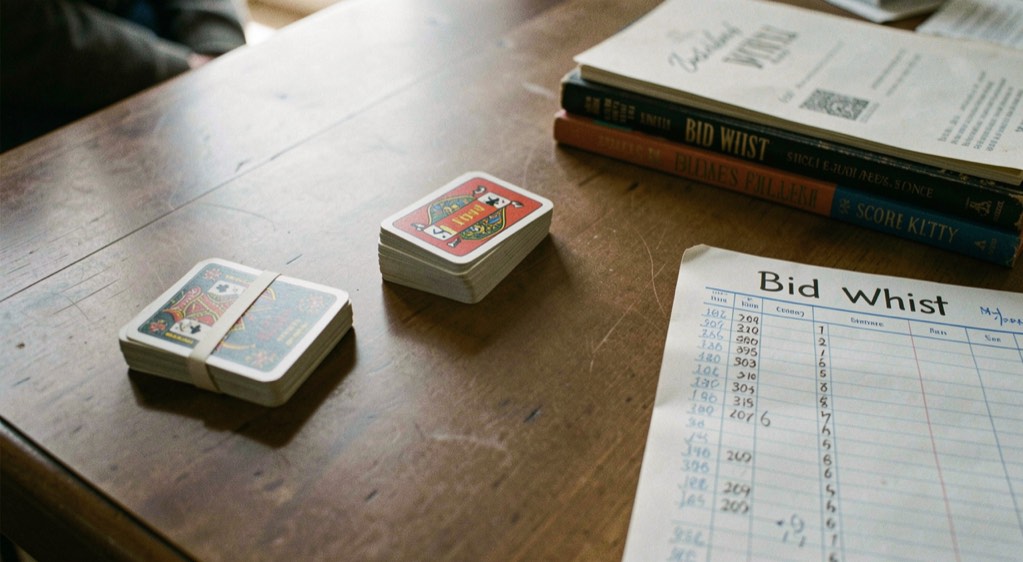
Bid Whist is the partnership descendant of whist that grew up in American card rooms, and it scores in a currency everyone at the table understands instantly: books. The first six tricks of any hand are the house's, taken for granted, and the auction sells the tricks beyond six. The scoring is compact, the vocabulary is vivid, and one hand can swing a whole evening, which is why the sheet matters as much here as in any game in the parlor.
The auction in books
Each partnership bids the number of books beyond six it commits to take: a bid of three is a promise of nine tricks, a bid of seven is every trick in the deck. Bids climb in whole books, and the winning bid names the condition of play: uptown, where high cards win; downtown, where low cards win and the deuce is a boss; or no trump, where suits mean nothing and every trick is rank alone. In common play the jokers ride on top in every condition, the biggest cards in the deck, and a hand without them is a different game entirely.
The kitty and the discard
Six cards go face down as the kitty before the auction. The winning bidder picks the kitty up, adds it to a hand that now runs nineteen cards, and discards any six face down before the first lead. The kitty is the auction's profit margin: a bid of four means the bidders expect to absorb six unknown cards and still take ten tricks, and the discard is where the contract is quietly made or lost. Defensive bidding exists partly to push the auction one book higher, because each extra book of kitty is another unknown the buyers must survive.
| Outcome | Score | Notes |
|---|---|---|
| Bid made exactly | one point per book bid | a bid of four scores four |
| Extra books taken | no bonus in the common book | some tables pay them, decide first |
| Bid failed, the bust | the bid scored to the opponents | the set pays what was promised |
| No trump bid made | double book value in many tables | the riskiest condition, often paid best |
| Boston: all thirteen books | seven, or the table's doubled value | an event, announced like one |
| Game | commonly the first to a fixed total | leagues often play a fixed number of hands instead |
Uptown, downtown, no trump
The three conditions change the deck's meaning without changing the scoring. Uptown plays as whist always did, ace high down to deuce, jokers atop all. Downtown inverts every suit, and the two of each suit becomes a monster: players who have never watched a deuce win the last book of a Boston have not really played Bid Whist. No trump strips the game to pure rank, and because the jokers still sit on top, a no trump hand holding both jokers is the closest thing the game has to a sure contract.
The Boston and the near misses
Taking every book, the Boston, is scoring and spectacle at once: the common book pays it as a bid of seven, and most tables double it in no trump. Near Bostons carry their own drama, because a partnership at twelve books facing one last lead defends or delivers the whole evening's story. The scoring sheet handles both the same way, seven or fourteen in the books column, but the table remembers them differently, which is exactly as it should be.
The defensive bid
Bid Whist auctions have a defensive tradition the scoring has to anticipate: overbidding the opponents by one book to push them into a hand they must now survive with the kitty. The overcaller prices the risk exactly as the table reads it, one more book promised, one more book payable to the opponents on a bust. In the common book the overbid costs nothing when it makes and pays the full bid when it fails, so the defensive bid is a wager at even money with the kitty as the hidden extra stake. Tables that score busts at the bid value, rather than at some rounded penalty, produce the cleanest defensive auctions, because everyone can do the arithmetic before the first lead.
Common mistakes
Bidding books the kitty cannot plausibly deliver, the classic newcomer error. Discarding winners to keep length, thereby donating the bust. Letting the sheet record the bid after the hand instead of before, which turns the auction into archaeology. Playing jokers as ordinary high cards in downtown, when they top everything in every condition. And forgetting that a failed bid pays the full promise to the opponents, so a timid overbid by one book costs exactly as much as a brave one.
Books on the sheet, books on the table
Bid Whist rewards the table that treats the auction as arithmetic: six books belong to the house, each further book is purchased, and the kitty is the warehouse the purchase must survive. The columns that carry these numbers are drawn in the score sheets guide, the partnership spades game that shares the bid instinct is compared in the spades rules, and the rotation that turns the game into a full evening is in the euchre tournament format, which works for Bid Whist tables with one arithmetic change.